

5 Signs Your Brand Foundation Needs Attention Before Your Marketing Tactics Do
You built the website. You launched the Instagram. You started posting, showing up at events, handing out samples, sending emails when you could. You did all the things the podcasts and the marketing blogs told you to do.
And yet.
Sales are inconsistent. Your social posts get polite engagement from friends but silence from strangers. You can't tell which of your efforts are actually generating customers and which are just generating activity. Someone asks what you do at a networking event and you give a slightly different answer than you gave last time, and neither version quite lands.
If this sounds familiar, you're not alone. You're also not doing it wrong. You've likely hit an inflection point that nearly every founder reaches, and it has very little to do with how hard you're working.
The inflection point no one warns you about
There's a stage in building a business where effort stops being the variable that matters most. In the beginning, effort is everything. You need to ship the product, build the site, open the accounts, show up at the first event. Hustle works because anything is better than nothing.
Then a shift happens. You've done the work. The infrastructure exists. The product is real. And the question changes from "am I doing enough?" to "am I doing the right things?"
That's the inflection point. And it's disorienting because the tactics that got you here, doing a little of everything, trying every platform, saying yes to every opportunity, are the same tactics that are now keeping you stuck.
The founder who markets to everyone reaches no one deeply. The founder who posts on six platforms has a presence on six platforms and traction on zero. The founder who gives a different elevator pitch every time confuses the people who might actually buy.
This is not a marketing problem. It's a clarity problem. And clarity is the single most underleveraged asset in early-stage business.
Five signs your brand foundation needs attention before your marketing tactics do
Before you hire an agency, commission a redesign, or invest in a new platform, check these five areas first. These are the foundational cracks that no amount of tactical execution can paper over.
1. You can't describe what you do in one sentence that makes a stranger lean in.
Try this right now. Set a timer for ten seconds. Describe your business to an imaginary stranger at a coffee shop. One sentence. No jargon, no feature lists, no "we help people who..."
If you couldn't do it, or if the sentence felt clunky, the problem isn't your speaking ability. The problem is that the positioning underneath the sentence hasn't been sharpened yet.
What to do about it: Stop leading with what you sell. Start leading with the problem your buyer already knows they have. Try this exercise:
Fill in this template and say it out loud:
"Have you ever experienced [specific problem your customer feels]? (pause, wait for the nod) Well, that's the product I built. It's a [one-sentence description of your solution] and [the outcome it creates]."
Here's what that sounds like in practice: "Have you ever experienced those muscle aches at night that keep you up, and you wish you had something healthy and clean to help that wasn't a pain killer? Well, that's the product I built. It's a low-sugar CBD oil that I put under my tongue at night, and I sleep like a dream."
Notice what's happening. The first sentence isn't about you or your product. It's about a feeling your customer already has. The pause gives them space to say yes. By the time you describe what you built, they're already leaning in because you named their problem before you offered your solution. That's the difference between a pitch and a conversation.
2. You don't know who your best customer actually is.
"Anyone who could benefit from what I offer" is not a target customer. Neither is a demographic range like "women 25-55 who care about wellness." Those descriptions are too wide to inform any meaningful decision about where to show up, what to say, or how to price.
Your best customer is a specific person with a specific problem, and a specific set of behaviors, habits, needs, challenges, and desires. Until you can describe that person with enough detail that you could pick them out of a crowd, your marketing will keep speaking to everyone and landing with no one.
What to do about it: Look at your existing customers, even if you only have a handful. Who bought more than once? Who referred someone? Who gave you unsolicited feedback? Study those people. What do they have in common? That commonality is your target customer, and it's probably not what you assumed when you launched.
If you're pre-revenue, study the people who engage most with your content or who ask the most questions at events. Curiosity is a leading indicator of intent.
3. Your strongest story isn't on your website.
Nearly every founder I've met has a personal story that is deeply connected to why they started their business. A health crisis that led them to natural alternatives. A frustration with an industry that wasn't serving people well. A personal experience that made them think "someone needs to fix this."
These stories sit in the founder's head, get shared with friends and family, sometimes get hinted at on an About page. But they rarely show up as the central brand asset they are.
Here's why this matters: in a market full of similar products, your story is the one thing no competitor can replicate. Your ingredients can be copied. Your pricing can be undercut. Your features can be matched. Your story cannot.
What to do about it: Write your origin story in full. Not the polished version. The real one. Include the moment you decided to start this business, what you were feeling, and what personal experience made the problem real to you. Then read it back and ask: would a stranger who read this understand why I care so deeply about what I'm building? If yes, that story belongs front and center in your brand. If you're not sure how to position it, that's a sign you need strategic help, not more content.
4. You're spending money on tactics before you've confirmed the foundation.
This is the most expensive mistake founders make, and it's completely understandable. When something isn't working, the instinct is to add. A new platform. A paid ads campaign. A social media manager. A booth at a conference. A website redesign.
Each of those can be the right move. None of them will work if the foundation underneath them is unclear. Running ads to an undefined audience wastes money. Hiring a social media manager before you've defined the brand voice produces content that doesn't sound like you. Redesigning the website before you've sharpened the positioning produces a prettier version of the same blurry message.
The average founder spends five to fifteen thousand dollars in their first two years on marketing investments that don't return, not because the tactics were bad, but because the foundation wasn't ready for them.
What to do about it: Before any marketing investment over five hundred dollars, ask yourself three questions. Can I clearly state who this is for? Can I clearly state what I want them to do after they encounter it? Can I measure whether it worked? If the answer to any of those is no, the investment is premature. Spend the time on clarity first. The money will work harder after.
Here's a simple filter that helps: print out pictures of your target customers participating in their lives. Hang those pictures up in your office and look at them when you're deciding on content, a new product, or hiring team members. Ask yourself: will this decision help and support these people? If the answer isn't a clear yes, the investment isn't ready.
5. You're the only one making marketing decisions, and you're exhausted.
If you're a solo founder handling product, operations, finance, customer service, and marketing, you already know this: marketing is usually the thing that gets squeezed. It's the ball that drops first because there's no one else to catch it.
The result is inconsistent content, reactive decision-making, and a nagging guilt that you should be doing more. Your content strategy becomes "I post when I have something to say." Your channel strategy becomes "I'm on Instagram because everyone says I should be." Your brand strategy becomes whatever feels right in the moment.
None of this is a character flaw. It's a resource constraint. But it means the decisions that matter most for your brand's growth, who you're for, how you show up, where you spend your limited hours, are being made under pressure without a framework.
What to do about it: Block two hours this week. Just two. Use them to answer three questions in writing: Who is my single most important customer right now? What is the one message I want that person to hear from my brand? What is the one channel where that person is most likely to find me? Write the answers down. Tape them to your monitor. For the next 30 days, filter every marketing decision through those three answers. Say no to everything that doesn't serve them. You'll accomplish more in a focused month than in six scattered ones.
The question underneath all of it
Every founder who hits the inflection point is really asking one question: where should I actually be putting my energy?
Not "what platform should I be on." Not "should I rebrand." Not "how do I get more followers." Those are downstream questions. The upstream question is about focus. And focus requires clarity about three things: who you're for, why you matter to them, and how you show up consistently.
When those three things are defined, the downstream decisions get dramatically easier. The right channel becomes obvious. The right message writes itself. The right investment stops feeling like a gamble.
When they're not defined, every tactic is a guess. And guessing is exhausting.
When you're ready for outside eyes
If you worked through the five areas above and found that most of them resonated, you're in good company. These are the most common patterns I see in founders who are working hard, building something real, and ready for the strategic clarity to make all that effort compound.
Some founders can work through these on their own. Others want a structured process and a strategist who has guided hundreds of brands through the same questions.
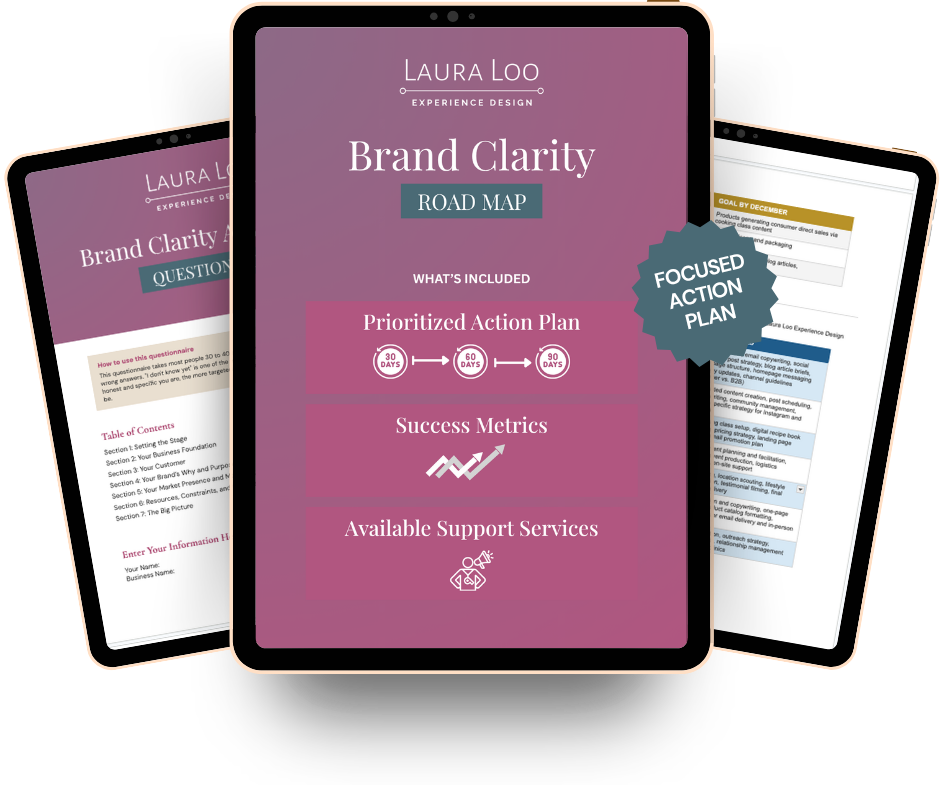
That's why I built the LLXD Brand Clarity Assessment. Imagine knowing exactly who your brand is for, what to say to them, and where to put your marketing effort and budget next. Together we diagnose what's working, what's holding you back, and the highest-leverage move to make first, so your content, events, social, and sales outreach all pull in the same direction. In two to three weeks you walk away with a clear roadmap and confident next steps.
If any of what you read here felt familiar, take a look. The next step is always the smallest one.


